Getting around
Manila
Grab is the default: ₱150–300 within a district, ₱300–500 across the metro, and it removes every taxi argument. Use LRT-1 for the historic corridor — Carriedo for Binondo, Central Terminal for Intramuros, UN Avenue for the museums — at ₱15–35 a ride. Use the EDSA Busway to beat traffic along the Ayala–Cubao spine while the EDSA rebuild runs to 2027. The Pasig River Ferry is free and the best-kept secret in the city. Never self-drive. And remember: nothing at all moves between 7–10am or 3–7pm.
When Manila's roads actually move
The average Metro Manila driver loses about 143 hours a year to traffic — roughly six days. The EDSA full-depth rebuild that started in December 2025 runs to 2027 and has made the afternoon band worse. This is the single most useful chart on the site: schedule your moves around it.
Good. The best daytime window for anything that involves a car.
How to move around Metro Manila
| Mode | Price | Use it for | Verdict |
|---|---|---|---|
| Grab | ₱150–300 in-district · ₱300–500 cross-metro | Almost everything. Surge +30–80% in rain and after midnight | WORTH IT |
| LRT-1 | ₱15–35 | The tourist line: Carriedo, Central Terminal, UN Avenue, Pedro Gil, south to PITX | WORTH IT |
| MRT-3 | ₱13–28 | The EDSA spine: Ayala, Ortigas, Cubao, North Avenue. Contactless cards accepted | WORTH IT |
| LRT-2 | ₱15–30 | Recto to Cubao and Antipolo — useful for the Pinto Art Museum run | DEPENDS |
| EDSA Carousel busway | ₱15–70 | Beating EDSA traffic in the median lane while the rebuild runs | WORTH IT |
| Pasig River Ferry | Free with ID | Escolta to Guadalupe. Mon–Sat, roughly 6am–6pm, every 30 min | WORTH IT |
| Jeepney | ₱13 traditional · ₱15 modern | Short hops and the experience. Say “bayad po” to pass your fare forward | DEPENDS |
| Moto-taxi (Angkas, JoyRide) | ₱120–250 Makati–BGC | Solo travellers in gridlock — 2–3× faster, helmet provided | DEPENDS |
| Tricycle / pedicab | ₱20–50 a hop | Last-mile only. No meter — agree the price first, every time | DEPENDS |
| Street taxi | ₱45 flag | Fine at malls and hotels. Say “meter po, kuya” | DEPENDS |
| Car with driver | ₱3,500–6,000 a day | Day trips to Tagaytay or Pampanga. The sane way to leave the metro | WORTH IT |
| Self-driving | — | Number coding, parking, and a driving culture you do not know | SKIP |
PNR commuter rail has been suspended entirely since March 2024 for construction — ignore any guide that lists it. The Metro Manila Subway has slipped to around 2031–32 and MRT-7 targets partial operations in 2027; neither is rideable now.
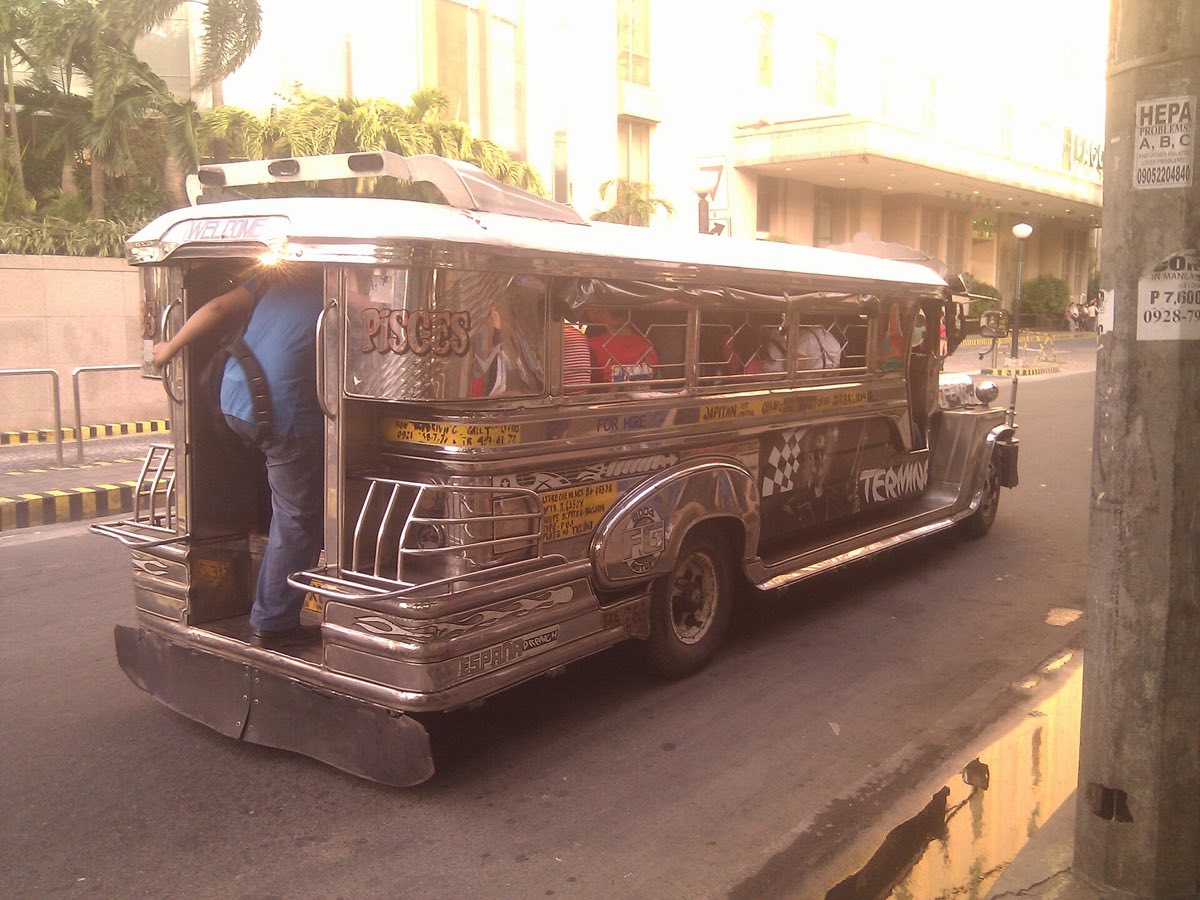
How to ride a jeepney, and why you should soon
The traditional jeepney is being phased out route by route. If you want to ride one, this is the decade to do it.
Flag it down anywhere along its route — the destinations are painted on the side. Climb in the back, sit on the bench, and pass your fare forward toward the driver with “bayad po”. Change comes back down the same chain of hands, which is the part visitors always enjoy.
To get off, say “para po” or knock on the rail. The minimum fare is ₱13 on a traditional unit and ₱15 on a modern one.
The tourist-useful routes run Taft to Intramuros and Divisoria. Keep your bag on your lap, exactly as you would anywhere else in the city.
The modernisation programme has been grinding along for years, with periodic strikes and route-by-route replacement of the classic stainless-steel units. Plenty still run in 2026, but fewer every year.
The two things worth pre-booking
Getting around Manila FAQ
What is the best way to get around Manila?
Grab for almost everything — ₱150–300 within a district, ₱300–500 across the metro, with no fare negotiation. Use LRT-1 for the historic corridor (Carriedo for Binondo, Central Terminal for Intramuros, UN Avenue for the museums) and the EDSA Busway along the Ayala–Cubao spine. Never self-drive.
How much is Grab from NAIA to Makati?
₱250–450 and 25–60 minutes depending on the hour. BGC runs ₱300–550, Malate ₱200–350 and Quezon City ₱400–700. Surge adds 30–80% in rain or after midnight. Use the designated Grab bay rather than accepting an offer inside the arrivals hall.
Is the MRT or LRT good for tourists in Manila?
LRT-1 is genuinely useful — it runs the historic corridor and now reaches the airport district at Asia World–PITX. MRT-3 is reliable since its rehabilitation and accepts contactless bank cards, but it is crushed at rush hour. Neither serves BGC, Poblacion or Entertainment City at all.
Should I get a Beep card in Manila?
Only if you are staying a week or more or plan to use rail daily. It costs ₱30 plus load and works on rail, the EDSA Busway and some jeepneys. For a two to four day Grab-centric trip, skip it — MRT-3 now accepts contactless bank cards and GCash at the gates.
Is the Pasig River Ferry worth taking?
Yes, and it is free — show ID and board. It runs Monday to Saturday from roughly 6am to 6pm, about every thirty minutes, across thirteen stations. Escolta to Guadalupe beats EDSA on a bad day and doubles as the cheapest sightseeing cruise in Asia.
Can you walk around Manila?
In pockets: Intramuros, BGC, Makati's core, Binondo's centre and the Baywalk are all walkable. Everything else is hostile — broken pavements, no shade, and a heat index of 35–45°C that makes two kilometres feel like five. Footbridges are mandatory rather than optional on the big roads.